JournalCompetition operations
The Competition Is More Than the Match
Spectators see a draw and a scoreboard. Organizers see weeks of entries, formats, court time, staff and late changes, usually held together by tools that do not talk to each other.
- Published
- Reading time
- 7 min
- By
- MEDALYA
In this article
A padel tournament rarely becomes difficult when the first ball is struck.
The difficulty starts weeks earlier. A club’s operations manager is confirming entries, chasing missing partner names, sorting players into categories and checking which courts are free on which evenings. A university sports office is collecting teams from a dozen faculties and trying to build a fixture list around lectures, exams and one shared hall. An independent organizer is choosing a format, booking officials, answering the same question about start times for the fortieth time, and hoping nothing changes on the morning of the event.
By the time the first match starts, the competition is already a substantial piece of operational work.
Most of that work runs through tools that were never designed to work together. Entries sit in a spreadsheet or a form export. Updates go out through a messaging group. The draw comes from a bracket generator, or is drawn by hand. Scores come back on paper, in photos, or in a direct message to whoever is at the desk. When something changes, the person with the most complete picture fixes it manually, and everyone else waits.
The match is visible. The operation behind it is not.
MEDALYA exists to make that operation manageable.
The work behind a competition
It helps to follow one event from start to finish. Picture a weekend padel tournament at a club: around thirty pairs, two categories, four courts, two days. The numbers are illustrative; the sequence is not.
Registration opens a few weeks out. Pairs sign up, some before their partner has confirmed. A few withdraw; others ask to join late. Each change alters how many places are left in each category and, eventually, which format makes sense.
The format has to fit the entries and the time available. Groups followed by a knockout need more court time than a straight knockout. Seeding has to be settled before the draw is published, because once players have seen the draw, changing it is a conversation nobody wants to have.
Then the schedule. Every match needs a court and a time. A pair entered in two categories cannot be on two courts at once. An official cannot referee two matches in the same slot. Losing one court on Saturday morning moves everything behind it.
On the day, check-in becomes part of the competition. Players arrive at different times and want to know when and where they play. One long match on Court 2 pushes back the next three. The desk needs to know which matches are live, which are ready to start, and which pair has not arrived.
Results come in from the courts, and each one decides who plays next, moves the standings and, eventually, the podium. A score recorded wrongly, or late, travels through everything that follows it.
When the final is over, the work is not. Someone has to confirm the results, settle the disputes, send the record to the people who need it, and remember enough to run the next edition better.
What spectators see
What the organizer runs
- 01Often: SpreadsheetEntries & categoriesConfirming pairs, partners, categories and withdrawals.
- 02Often: Bracket toolFormat & drawFitting the format and seeding to the entries and court time.
- 03Often: SpreadsheetCourts & scheduleGiving every match a court and a time without clashes.
- 04Often: Desk notesCheck-in & deskKnowing who has arrived, what is ready and what is running late.
- 05Often: Paper, chatLive scoringGetting each score from the court into the draw.
- 06Often: Files, memoryResults & recordConfirming results, settling disputes, keeping the record.
The bracket is one output of all this. It is not the operation.
Where fragmented tools break
Using several tools is not the problem in itself. The problem is that the connections between them are maintained by people.
Entries are copied into a draw. The draw is retyped into a schedule. The schedule is posted to a group chat as an image. A result is written on a sheet, entered into the bracket, then announced. Each handoff is a place where information can be lost, duplicated or left out of date, and none of them is visible until something goes wrong.
The cost shows up in small ways: a pair arriving for a match that was moved, two officials assigned to the same slot, a standings table that disagrees with the scoresheet, a late withdrawal nobody passed on to the desk. Each one is manageable. Together, on a busy day, they are what makes an event feel disorganized to the people playing in it.
Experienced organizers absorb much of this through attention and memory. That works for a single event run by the same person every time. It is much harder to sustain for an organization that runs competitions every month, with changing staff, across more than one venue.
One record, from entry to result
The answer is not more features. It is a single record that every part of the competition reads from and writes to.
In that model, a confirmed entry becomes a place in the draw. The format sets the shape of every match that follows. Matches are placed on courts and times, and conflicts are flagged as they appear. Check-in marks a pair ready, a ready match goes live, and a confirmed result moves the winner forward and updates the standings. When the event ends, the record of what happened, including the decisions made during play, already exists.
This is how MEDALYA is built. The workspace connects entries and the waitlist, draw formats, court scheduling with clash checks, QR check-in, live match control and confirmed results in one competition record, and exports that record as PDF or CSV. The product page walks through each layer.
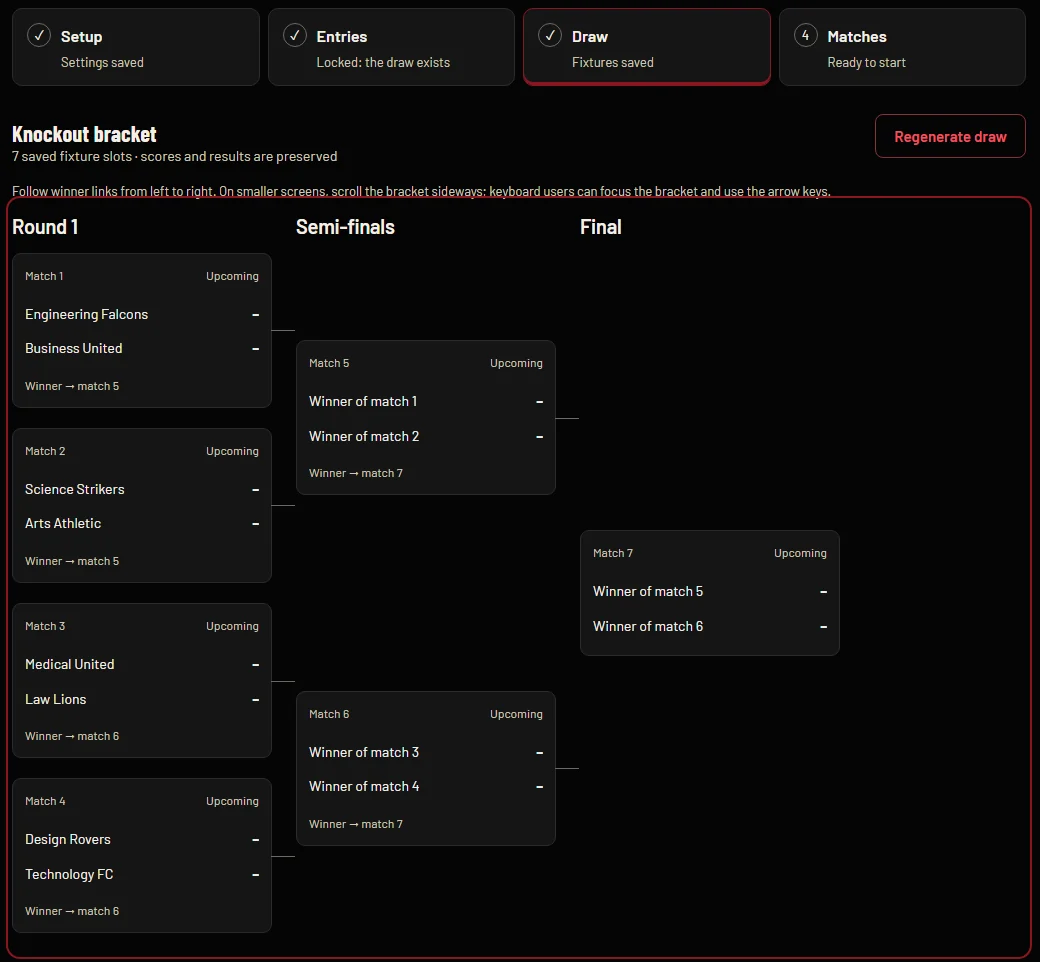
Parts of the platform are still being built, and we would rather say so plainly. Separate staff accounts and permissions for customer organizations are planned, not available. Subscriptions are not open yet; access today is a guided demo.
Separate toolsPeople carry it
- 01Entries exported from a form, then copied into a draw
- 02Schedule rebuilt in a spreadsheet and posted as an image
- 03Check-in and delays tracked on paper at the desk
- 04Scores sent by message, then re-entered in the bracket
- 05The final record assembled afterwards from files and memory
One competition recordThe record carries it
- 01Confirmed entries become places in the draw
- 02The draw’s matches go onto courts, with clashes flagged
- 03Check-in marks pairs ready; a ready match goes live
- 04A confirmed result advances the winner and updates standings
- 05The record exists as play happens and exports as PDF or CSV
A connected record is not automation for its own sake. Nothing moves on its own: the organizer still places the match, confirms the result and makes the call when something goes wrong. The difference is that every decision lands in one place, and everyone working the event sees the same thing.
Built for competitions that happen again
A one-off event can survive on improvisation. A recurring competition cannot.
A padel club may run a league, monthly tournaments and a summer series. A university sports office runs inter-faculty fixtures every term, often with a new student committee each year. An independent organizer may deliver events at several venues, each with its own courts and constraints.
The details change every time. The need for a dependable process does not. When the structure of a competition lives in a system rather than in one person’s spreadsheet, it can be repeated, handed over and improved. A new member of staff can see how the last edition ran. A disputed result can be traced back to the moment it was entered.
None of this takes judgment out of running a competition. Organizers will always make decisions about formats, venues and people that no software should make for them. The aim is to give those decisions a reliable foundation.
What players notice
Players rarely see the systems behind an event, but they feel the results straight away.
They notice whether registration was clear, whether the schedule made sense, whether they were told when a match moved, and whether results appeared quickly and correctly. For a club or a university, those details shape how the organization is seen by its members, its students and its partners.
A well-run competition is part of an institution’s reputation. The operation behind the match is what makes it look effortless.
Competition, Engineered.
That line is the idea MEDALYA is built around. The match is the part everyone sees. The competition is everything that makes the match possible, from the first entry to the final record, and it deserves software designed for all of it.
MEDALYA is preparing its first external pilot in Egypt. If you run recurring competitions at a club, a university or a venue, or as an independent organizer, we would like to show you your format running in the workspace and talk honestly about whether it fits.